Crawling Solutions
Crawling is the foundation of Cartographer. It discovers every component in a Dataverse solution and catalogs it, building the metadata that summaries, user guides, and diagrams are generated from.
What Crawling Does
When you crawl a solution, Cartographer queries the Dataverse metadata APIs to discover every component that belongs to that solution. It reads the raw metadata for each component — table definitions, column schemas, form XML, view FetchXML, plugin step registrations, cloud flow definitions, and more — and stores a normalized record in the Component table.
Crawling is solution-scoped, meaning you choose exactly which solutions to crawl. This is not a full-environment blast — you control which solutions are documented and which are ignored.
Incremental Crawling
After the first crawl, every re-crawl is incremental. Cartographer compares each component's current source against what it captured last time, and only reprocesses the ones that actually changed. A component whose source hasn't changed since the last crawl is skipped, not rewritten.
Fast re-crawls
Re-crawl a solution that hasn't changed and the crawl log reports zero created, zero updated, and everything skipped — finished in a couple of seconds instead of rebuilding the whole picture from scratch.
Adding a Solution to Crawl
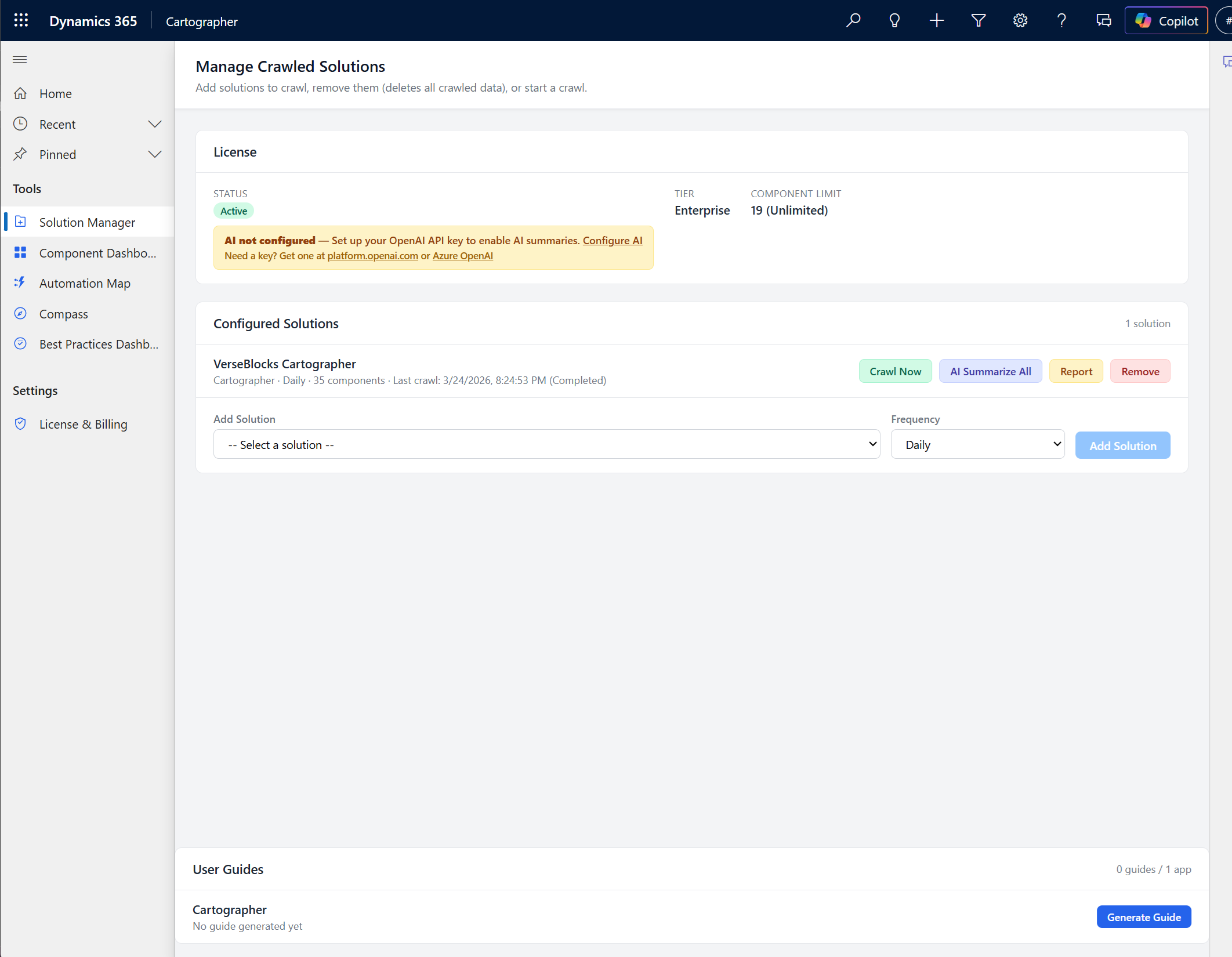
- 1
Open Solution Manager
In the Cartographer app, navigate to Solution Manager in the left sidebar.
- 2
Click Add Solution
Click the Add Solution button in the command bar. A panel will appear with a dropdown of all solutions in your environment.
- 3
Select a solution
Choose the solution you want to crawl from the dropdown. You can search by solution name. Only managed and unmanaged solutions are shown — default solutions (like the Common Data Service Default Solution) are excluded.
- 4
Configure crawl settings
Optionally set how often it should re-crawl — manual only, hourly, every six hours, daily or weekly. Daily is the default.
- 5
Save and Crawl
Click Save to add the solution. Then click Crawl Now to start the initial crawl. The progress indicator will show how many components are being discovered.
Component Types Discovered
Cartographer discovers components across your solution's data model, user interface, automation, web resources, and security configuration. Each type is processed differently to extract the most useful metadata.
Data Model
- Tables
- Columns
- Relationships
- Global Option Sets
User Interface
- Forms
- Views
- Charts
- Dashboards
- Model-Driven Apps
- Site Maps
Automation
- Plugin Assemblies
- Custom APIs
- Plugin Steps
- Cloud Flows (Automated)
- Cloud Flows (Scheduled)
- Cloud Flows (Instant)
- Classic Workflows
- Business Rules
- Business Process Flows
Web Resources
- JavaScript
- HTML
- CSS
- Images (SVG, PNG, ICO)
Security & Configuration
- Security Roles
- Connection References
- Environment Variables
Crawl Frequency
You can configure how often Cartographer re-crawls each solution to keep documentation up to date.
| Frequency | Description |
|---|---|
| Manual Only | Crawl only when you click "Crawl Now" |
| Hourly | Re-crawls every hour |
| Every 6 Hours | Re-crawls four times a day |
| Daily | Re-crawls once every 24 hours. This is the default. |
| Weekly | Re-crawls once every 7 days |
Re-crawling and Removing Solutions
Re-crawling
Click Crawl Now on any solution to trigger an immediate re-crawl. Incremental crawling means unchanged components are skipped. Use Full Re-crawl if you want to discard all cached data and start fresh.
Removing a solution
To stop crawling a solution, select it in Solution Manager and click Remove. The confirmation dialog states how many component records will be deleted and requires typing DELETE to confirm. This removes the crawl configuration and all associated component records from the Cartographer database. It does not affect the actual solution in your environment.
Crawl Log
Every crawl operation is recorded in the Crawl Log. You can view it from the Solution Manager to see:
- Start and end timestamps
- Counts of components created, updated, skipped, and removed
- Crawl duration
- Any errors or warnings encountered
- Whether the crawl was manual or scheduled
Next Steps
Once your solution is crawled, every component already has a plain-English summary, generated automatically from what was discovered.