User Guides
User Guides are Markdown documentation generated for your model-driven apps, built deterministically from the crawled data. They describe every area, table, automation, and integration an app touches — free, for every app, with nothing to configure.
What Are User Guides?
Model-driven apps often lack end-user documentation. Teams build apps, but nobody writes the manual. User Guides solve this by assembling the app's sitemap, tables, forms, views, and automations — everything Cartographer already crawled — into a structured guide that explains how the app is put together.
The guide is built the same way component summaries are: from a deterministic template, not a language model. There is no AI involved and nothing is sent anywhere — the guide is assembled entirely from metadata already sitting in your own environment.
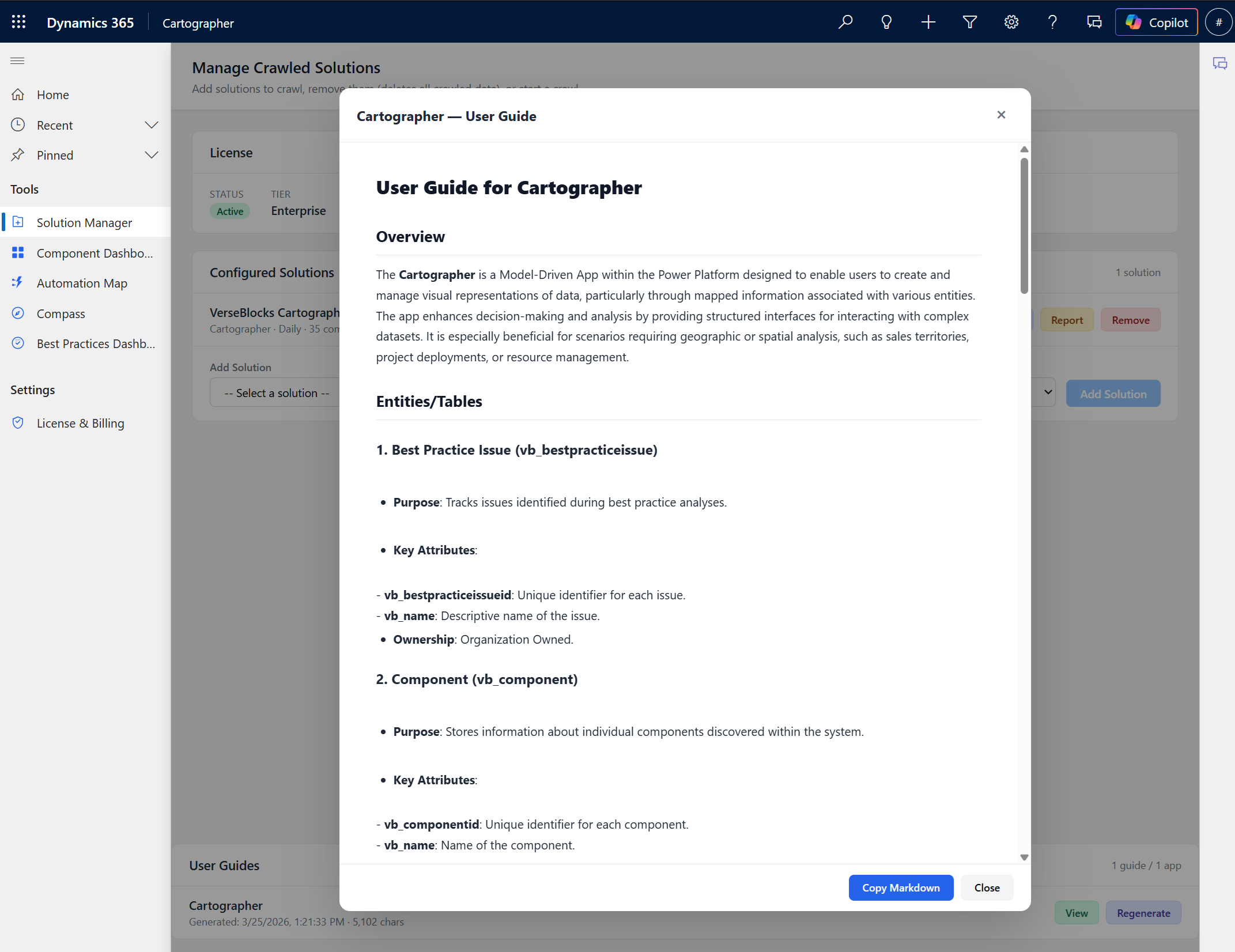
The generated guide is written in Markdown and can be viewed directly in Cartographer or copied to a wiki.
How to Generate a User Guide
- 1
Navigate to Solution Manager
Open the Cartographer app and go to Solution Manager.
- 2
Find the User Guides section
It lists every model-driven app found across all of your crawled solutions, one row per app.
- 3
Click Generate Guide
Click Generate Guide next to the app you want to document — or Regenerate if it already has one and you want to refresh it after changes.
- 4
View the guide
Once generation finishes, click View to open the guide in a formatted preview panel.
What's Included in a Guide
Every guide is built from the same nine sections, in order:
Counts captured by the crawl — tables, forms, views, automations, integrations, security roles, and plugin assemblies referenced by the app
The app's sitemap, walked area by area, group by group, down to each sub-area
Every table the app references
Cloud flows, plugin steps, classic workflows, business rules, business process flows, and custom APIs, grouped together
Each custom API's own call contract — bound or unbound, request parameters, and response properties
Connection references, custom connectors, and environment variables the app depends on
The assemblies that ship with the solution and the plugin types each one contains
The security roles captured for the crawl configuration
Table logical names and component unique names, for translating between what users see and what's underneath
Viewing and Copying
User Guides are stored in Markdown format and can be used in a couple of ways:
- View in Cartographer — the guide renders in a formatted preview pane directly in the app
- Copy Markdown — copy the raw Markdown to your clipboard and paste it into a wiki (SharePoint, Confluence, Notion, GitHub), documentation site, or any Markdown editor
Regenerating Guides
When your app changes — new forms, updated views, additional areas — you should regenerate the User Guide to keep it current. Find the app in the User Guides section of Solution Manager and click Regenerate. Cartographer rebuilds the guide from the latest crawl data and overwrites the previous version.
We recommend regenerating guides after major solution updates, especially after adding new tables, forms, or sitemap areas to an app — and re-crawling the solution first, so the guide is built from current metadata.